Those working across women’s justice will recognise the context this report speaks to: rising demand, stretched services, and the ongoing need to evidence the value of specialist provision. What this report offers, though, is a clear example of how much can be achieved when organisations come together with a shared purpose.
The newly published impact report from the National Women’s Justice Coalition (NWJC) offers a valuable reflection on the meaningful change that coordinated, sector-led working can create within the justice landscape.
In just four years, the NWJC has developed from a small group of organisations into a recognised voice on women’s justice, supporting policy engagement, strengthening practice, and elevating the role of women’s specialist services.
At a time when the sector is facing ongoing uncertainty, the report offers both a sense of progress and a demonstration of the impact of collaborative working.
A coalition approach to influence
The report sets out a wide range of activity delivered since 2021.
This includes the development of the UK’s first national Women’s Services Map and the establishment of a National Voice and Advisory Panel of women with lived experience. Together, these initiatives have helped to build the infrastructure needed to support more effective policy engagement and service development.
Just as importantly, the coalition has brought together 26 organisations to work in a more coordinated way, sharing insight, aligning messages, and engaging collectively with national policy processes. In a system that can often feel fragmented, this kind of collaboration really matters, and it is something many organisations have been working towards for a long time.
Supporting a more consistent understanding of women’s services
A key theme within the report is the ongoing need to improve understanding of women’s centres and specialist provision within policy and commissioning contexts.
By bringing together evidence, publishing briefings, and developing accessible tools, the NWJC has supported the sector to articulate more clearly the value of gender-specific, trauma-informed services. This is not about saying anything new, but about saying it more consistently, and in ways that land with decision-makers.
The report suggests this has contributed to a gradual shift. In some areas, there is now a stronger shared understanding of the Women’s Centre Model, meaning organisations can spend less time explaining their approach and more time delivering it.
Contributing to discussions on funding and commissioning
The report also highlights activity aimed at strengthening the case for sustainable investment in women’s services.
Within a context of ongoing funding pressures and short-term commissioning cycles, the NWJC has coordinated evidence, engaged with decision-makers, and contributed to discussions on commissioning practice.
While it is difficult to attribute change to any single organisation, the report points to examples where this collective approach has supported improvements, such as greater recognition of gender-specific provision and more accessible commissioning processes for smaller, specialist organisations.
This reflects the value of sustained, evidence-led engagement, work that is not always visible, but plays an important role in shaping the direction of policy and practice over time.
Centring lived experience and addressing inequality
A defining feature of the NWJC’s work is its commitment to lived experience leadership and anti-racist practice.
The establishment of the National Voice and Advisory Panel represents a shift towards more meaningful involvement of women with lived experience, recognising this as expertise that should inform policy and service design, rather than something consulted on at the margins.
Alongside this, the coalition has taken steps to reflect on its own practice and address inequalities within the sector, particularly in relation to the experiences of small, specialist, by-and-for organisations.
This is ongoing work, but it signals an important direction of travel, one that is grounded in both collaboration and accountability.
Why this matters for the wider sector
For Clinks members and the wider voluntary sector, the report offers more than a summary of activity. It provides a practical example of how collaboration can support more effective engagement with complex systems.
It highlights that:
- working collectively can strengthen influence and credibility
- shared evidence can support more consistent policy conversations
- infrastructure plays a key role in making services visible and understood
- lived experience must be embedded meaningfully within decision-making
Perhaps most importantly, it reinforces something many in the sector will recognise: systems change is rarely the result of a single organisation. It happens through sustained, collective effort across a wider ecosystem of organisations, relationships, and influence.
Looking ahead
The NWJC is clear that its role remains important. Pressures across the criminal justice system continue, and demand for women’s specialist services shows no sign of slowing.
At a time when much of the focus is on pressure and constraint, there is something important in seeing what collective, sustained effort can build.
But the report also offers a sense of cautious optimism. It shows that when the sector works together, sharing knowledge, aligning messages, and building collective voice, it is possible to influence policy, strengthen practice, and improve outcomes for women in contact with the criminal justice system.
Clinks is proud to continue supporting the work of the NWJC through the development of the women’s services map and the engagement of NWJC members in Clinks’ Women’s Forum.
“Stronger together” is not just a title, it reflects an approach that continues to shape how change happens across the sector.
Read the full report from the NWJC here
What's new

Publications
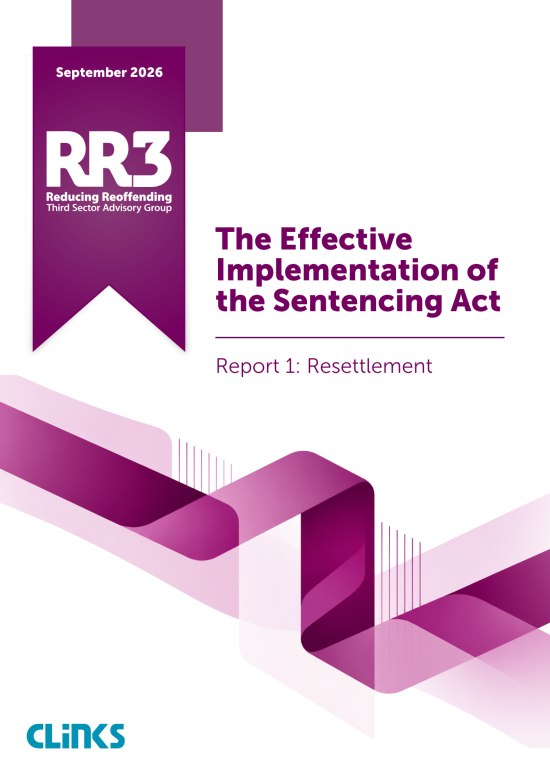
The Effective Implementation of the Sentencing Act - Report 1: Resettlement
This report from the RR3 Senten
Latest on X
 Clinks @clinks_tweets · 1 year
The role is for a leader from an organisation focused on racially minoritised people, with expertise in service delivery, policy, advocacy, or related areas in criminal justice. Racial disparities are present at every CJS stage. This role ensures these voices are central in shaping policy to help address and eradicate them. Apply by Mon 18 Nov, 10am. More info: https://www.clinks.org/voluntary-community-sector/vacancies/15566 #CriminalJustice #RR3 #RacialEquity