The publication of the Independent Monitoring Boards (IMB) National Annual Report should be required reading for anyone interested in the future of our prison system.
The report paints a stark picture of life behind prison walls. It describes overcrowding, poor mental health, self-harm, inadequate healthcare provision, limited time out of cell, reduced access to education, and people being released without the support they need to rebuild their lives.
While none of these findings are new, what is particularly striking is how closely they mirror the concerns raised by the Chief Medical Officer (CMO) in his landmark report on the health of people in prison, probation and secure settings published just six months earlier.
Two independent reports, produced from different perspectives, have arrived at many of the same conclusions.
That should concern us all.
The gap between ambition and reality
Across health and justice, there is broad agreement about what prisons should be for.
We talk about rehabilitation, reducing reoffending, improving health outcomes, supporting recovery from addiction, strengthening family relationships and helping people reintegrate into society.
These ambitions are reflected in government strategies, NHS plans, HMPPS priorities and the work of countless organisations across the voluntary, community and statutory sectors.
Yet the lived reality described in the IMB report often looks very different.
People in prison continue to spend excessive amounts of time locked behind their doors. Many struggle to access meaningful education, training or rehabilitative opportunities. People with severe mental illness wait months, and sometimes years, for transfers to appropriate mental health facilities. Others are released into homelessness or uncertainty, despite widespread recognition that stable housing is one of the most important foundations for successful resettlement.
The question we must ask is whether the system is currently delivering rehabilitation or whether it is increasingly focused on containment.
When containment becomes the priority
The IMB report repeatedly highlights the impact of overcrowding and population pressures across the prison estate.
Staff are working under immense pressure. Healthcare services are stretched. Education provision is being reduced. Progression pathways are delayed. Mental health needs continue to rise.
In these circumstances, prisons inevitably focus on maintaining order, managing risk and getting through the day.
These are understandable operational realities, but they create a significant challenge. When resources are stretched to their limits, rehabilitative activity can become secondary to containment.
The result is a system that often appears to be managing people rather than meaningfully supporting change.
This is not a criticism of frontline staff, many of whom continue to deliver exceptional work in extremely difficult circumstances. Rather, it is a reflection of a system under sustained pressure, where the gap between aspiration and capacity continues to widen.
The Chief Medical Officer warned us
One of the most powerful aspects of the IMB report is how closely it aligns with the findings of the Chief Medical Officer's report.
The CMO highlighted the significant health inequalities experienced by people in contact with the criminal justice system, the high prevalence of mental illness, substance use, trauma and long-term health conditions, and the need for a whole-system response to improving health outcomes.
The IMB report provides evidence of what happens when those challenges remain unresolved.
Six months later, we are still reading about prisoners waiting excessive periods for mental health treatment. We are still seeing high levels of self-harm and distress. We are still hearing concerns about continuity of care, resettlement support and the impact of prison conditions on health and wellbeing.
The consistency between the two reports is difficult to ignore.
When two independent bodies identify the same concerns within such a short period of time, the conversation should move beyond recognising the problems and focus on how meaningful change can be delivered.
The growing burden on the voluntary sector
The report also raises important questions about the increasing pressure being placed on the voluntary and community sector.
When statutory services are unable to meet all identified needs, those needs do not disappear.
They are often picked up by charities, community organisations and peer-led services supporting people in prison, on probation and in the community.
Across England and Wales, voluntary sector organisations provide vital support around housing, employment, substance use recovery, mental health, family relationships, financial inclusion and social reintegration. They often work with people who have experienced multiple disadvantage, trauma and exclusion throughout their lives.
As pressures within the prison system increase, demand for these services inevitably increases too.
Yet funding has not always kept pace with this growing complexity and demand.
Many organisations are being asked to support people with increasingly complex needs while operating within short-term funding arrangements and managing workforce pressures of their own. There is a real risk that the voluntary sector is expected to absorb the consequences of wider systemic pressures without receiving the sustainable investment needed to do so effectively.
If rehabilitation is genuinely a shared responsibility, then investment must extend beyond prison walls.
The voluntary sector is not an optional addition to the system. It is a critical partner in improving health outcomes, reducing reoffending and supporting people to rebuild their lives.
Listening to lived experience
Perhaps the most important lesson from both the IMB and CMO reports is the importance of listening to people with lived experience.
Many of the issues highlighted in both reports are not new. People in prison, people on probation, families and voluntary sector organisations have been raising these concerns for years.
They have spoken about the impact of isolation, uncertainty, poor mental health support, lack of meaningful activity and barriers to successful resettlement.
The challenge is not identifying the problems. The challenge is acting on what we already know.
Moving from recognition to action
The IMB report should not be viewed as another annual snapshot of a system under pressure.
Instead, it should be seen as a call to action.
The evidence from both the IMB and the Chief Medical Officer points in the same direction. We know that health and rehabilitation are inseparable. We know that stable housing, education, purposeful activity, healthcare and community support are essential to reducing reoffending. We know that the voluntary sector plays a vital role in achieving these outcomes.
Most importantly, we know that people cannot rebuild their lives if systems are focused primarily on containment rather than rehabilitation.
The question now is not whether we understand the challenges.
The question is whether we are prepared to invest in the solutions.
Six months after the publication of the Chief Medical Officer's report, the Independent Monitoring Boards have reminded us that the same issues remain. If we are serious about improving outcomes for people in prison and creating safer communities, we must move beyond acknowledging these challenges and commit to addressing them.
Otherwise, rehabilitation risks remaining an ambition that exists in policy documents rather than a reality experienced by the people the system is intended to support.
What's new

Publications
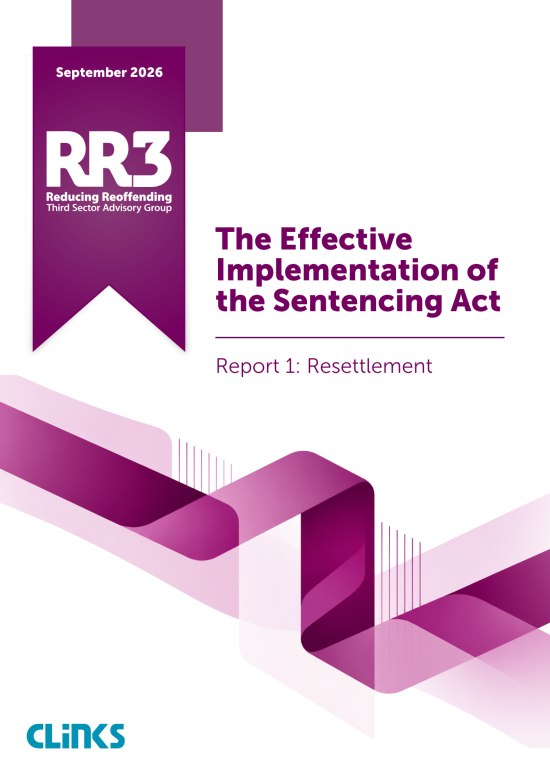
The Effective Implementation of the Sentencing Act - Report 1: Resettlement
This report from the RR3 Senten
Latest on X
 Clinks @clinks_tweets · 2 years
The role is for a leader from an organisation focused on racially minoritised people, with expertise in service delivery, policy, advocacy, or related areas in criminal justice. Racial disparities are present at every CJS stage. This role ensures these voices are central in shaping policy to help address and eradicate them. Apply by Mon 18 Nov, 10am. More info: https://www.clinks.org/voluntary-community-sector/vacancies/15566 #CriminalJustice #RR3 #RacialEquity